At a glance
- The event organiser holds primary responsibility for the health, safety and welfare of people working at or attending the event.
- The Northern Ireland Ambulance Service does not routinely provide medical cover at public events.
- The right level of cover comes from a medical risk assessment of your event, not from a fixed formula.
Before you use this guide
This is general information, not a diagnosis or a substitute for care from a clinician who knows your medical history. Seek urgent help for severe or rapidly worsening symptoms.
Who is responsible for medical cover at an event?
The organiser is. The Northern Ireland Ambulance Service (NIAS) states that the event organiser holds primary responsibility for protecting the health, safety and welfare of everyone working at or attending the event. NIAS also makes clear that it does not routinely provide medical services to public events, so cover needs to be arranged by the organiser.
Health and safety law sits behind this. In Northern Ireland, employers have responsibilities for their employees and for visitors such as customers and the general public. Under the Health and Safety (First-Aid) Regulations (Northern Ireland) 1982, which HSENI is responsible for, employers must make arrangements so that employees receive immediate attention if they are injured or taken ill at work, based on an assessment of first aid needs.
Those regulations focus on employees. HSE guidance for Great Britain strongly recommends that event organisers include the visiting public in their first aid, medical and ambulance needs assessment. Northern Ireland council guidance takes the same practical approach: plan medical, first aid and ambulance provision so the event has as little impact as possible on local health services.
Guidance: Northern Ireland Ambulance Service: Public event enquiry; nidirect: Employers’ health and safety responsibilities; HSENI: First aid at work; HSE (Great Britain): Event safety, planning for incidents and emergencies; Causeway Coast and Glens Borough Council: Event Management Guide (April 2023)
How to assess the medical risk of your event
Every event is different. Causeway Coast and Glens Borough Council’s event guide says the level of medical provision can only be determined after a comprehensive risk assessment, and that there are no off-the-peg solutions. Planning should be proportionate to the scale of the event and the degree of risk.
The council guide lists the factors a medical risk assessment should consider. Useful questions include:
- How many people will attend, and when the busiest periods will be.
- The audience profile, such as age, families or high-risk groups, and the type of entertainment.
- The activities taking place on site, including any special effects, structures or high-risk activity such as motorsport.
- Whether alcohol will be available, and whether some people may have taken drugs.
- The location of the site, access for vehicles and the distance to definitive care. Your nearest hospital may not have an emergency department, so check and test the travel time to the nearest A&E.
- How long the event lasts, whether people will queue, and the time of year and likely weather.
- Overnight camping, and what happened at previous editions of the event.
Guidance: Causeway Coast and Glens Borough Council: Event Management Guide (April 2023); Derry City and Strabane District Council: Items required for an outdoors entertainments licence; HSE (Great Britain): Event safety, getting started
Where the Purple Guide fits in
The Purple Guide to Health, Safety and Welfare at Music and Other Events is industry guidance produced by the Events Industry Forum. HSE notes that it includes example first aid and medical assessments for an audience at an event, and NIAS refers organisers to it as good practice guidance.
The Purple Guide is a subscription publication. If your event is large or complex, it is worth reading the medical chapter yourself and asking your medical provider to explain how their recommendation relates to it.
Guidance: HSE (Great Britain): Event safety, planning for incidents and emergencies; Northern Ireland Ambulance Service: Public event enquiry; Causeway Coast and Glens Borough Council: Event Management Guide (April 2023)
Levels of cover: from first aiders to ambulances
Medical cover is not one fixed package. Depending on the risk assessment, it may combine several of the following. The mix, numbers and positions should come from the assessment and be agreed with your provider.
- First aiders on foot or on bicycles, who can reach people quickly in crowds.
- Clearly signed first aid posts, marked on the site plan, with radio contact to event control.
- Clinicians such as nurses, paramedics or doctors where the activity, audience or distance to hospital calls for a higher level of care.
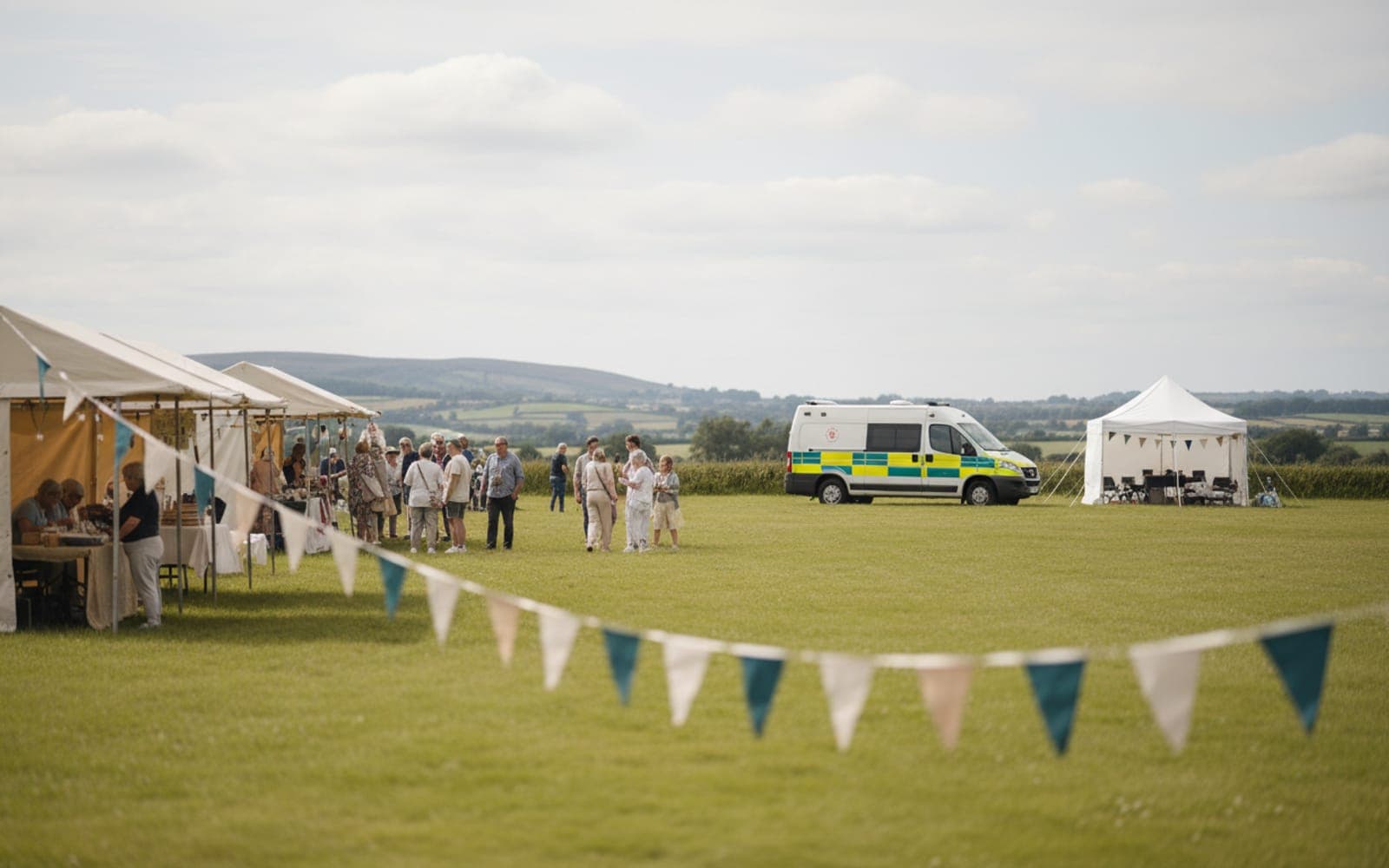
- An ambulance and crew on site, where the risk assessment shows one is needed.
- A treatment area or mobile treatment centre, so people can be assessed and treated on site.
- A named medical manager from the provider to take overall control and co-ordination of first aid provision.
Guidance: Causeway Coast and Glens Borough Council: Event Management Guide (April 2023); St John Ambulance (NI): Event services; HSE (Great Britain): Event safety, planning for incidents and emergencies
Council licensing and the Safety Advisory Group
Certain types of entertainment need an indoor or outdoor entertainment licence from your local council, and an occasional liquor licence is needed to sell alcohol away from licensed premises. Requirements vary by council, so contact yours early.
Councils expect to see your medical arrangements. Derry City and Strabane District Council’s list of items for an outdoors entertainments licence includes an event management plan covering medical and first aid arrangements on site. Causeway Coast and Glens’ guide asks for a site plan showing first aid points, and says first aid arrangements must be in position one hour before the gates open.
For larger or more complex events, the council may arrange a Safety Advisory Group (SAG) meeting with specialist officers from the council, PSNI, Northern Ireland Fire and Rescue Service, NIAS and others. You will usually be asked to share your event plan, site plan and risk assessments. The group is advisory, and its purpose is to help you run a safe event.
Guidance: nibusinessinfo: Regulations and licences for events; Belfast City Council: Entertainment licence; Derry City and Strabane District Council: Items required for an outdoors entertainments licence; Causeway Coast and Glens Borough Council: Event Management Guide (April 2023)
Telling the ambulance service about your event
NIAS asks organisers to complete its event information questionnaire, and to contact it if the event is likely to affect ambulance service delivery. Its examples include motorsport and other high-risk activities, and events involving road closures or occasional alcohol licences. NIAS also recommends notifying your local council and attending any Safety Advisory Group meeting if invited.
Large events should always be notified. In a major incident, NIAS is responsible for setting up casualty assessment and deciding which hospital casualties go to, so it needs to know your event is happening.
Guidance: Northern Ireland Ambulance Service: Public event enquiry; nibusinessinfo: Manage health and safety when running events
Booking early and choosing a provider
Start early. Causeway Coast and Glens suggests allowing 10 to 12 weeks for an entertainments licence and starting to plan a major event at least 12 to 18 months ahead. Medical providers have limited crews and vehicles on busy dates, and St John Ambulance (NI) notes that large events often need planning up to twelve months in advance.
Choose a provider who is competent for your type of event. HSE guidance for Great Britain suggests checking a contractor’s suitability and competence, the training of its workforce and, where relevant, membership of an accreditation scheme, professional organisation or trade association. Ask how the provider will co-ordinate with event control, how patients will be handed over or taken to hospital, and how incidents will be recorded. Jace Medical Ambulance is a member of the Independent Ambulance Association.
A provider can give a clearer recommendation when you share:
- The event type, date, timings and location.
- Expected attendance and the audience profile.
- Site access, welfare areas, crowd movement and known risks.
- Any previous medical incidents at the event.
- Any council, venue, insurer or licensing requirements.
Guidance: Causeway Coast and Glens Borough Council: Event Management Guide (April 2023); St John Ambulance (NI): Event services; HSE (Great Britain): Event safety, getting started
Common questions
Questions about this topic.
Not routinely. NIAS states that it does not routinely provide medical services to public events, so organisers arrange cover through voluntary or private providers. NIAS does ask organisers to tell it about events that could affect ambulance service delivery.
Sources and further reading
We use authoritative UK guidance and patient information. External sources may be updated after this guide is published.
- Northern Ireland Ambulance Service: Public event enquiry
- Causeway Coast and Glens Borough Council: Event Management Guide (April 2023)
- Derry City and Strabane District Council: Items required for an outdoors entertainments licence
- nibusinessinfo: Manage health and safety when running events
- nibusinessinfo: Regulations and licences for events
- Belfast City Council: Entertainment licence
- HSENI: First aid at work
- nidirect: Employers’ health and safety responsibilities
- HSE (Great Britain): Event safety, planning for incidents and emergencies
- HSE (Great Britain): Event safety, getting started
- St John Ambulance (NI): Event services